The Sword of Decision
Second Sunday of Advent. Fr Matthew Jarvis recalls that divine justice is never blind.
Two images spring to mind as I hear this gospel reading of St John the Baptist’s preaching: the Call of St Matthew by Caravaggio and the Old Bailey courthouse in London. In both cases, there is a sword of decision.
Caravaggio’s Call of St Matthew is dear to me for obvious reasons. But it is a masterpiece that can speak to everyone seeking conversion. According to one interpretation, Matthew is not one but four of the figures round the table. Each person represents Matthew in a stage of his conversion, starting with the young man sinfully bent upon his money, progressing to the bearded man awakened by the call of Christ, then the boy with a face flushed with fresh innocence, leading finally to the young man getting up off the bench, ready for action as he decides to follow Christ. And that young man is reaching for the sword on his belt: the sword of decision.
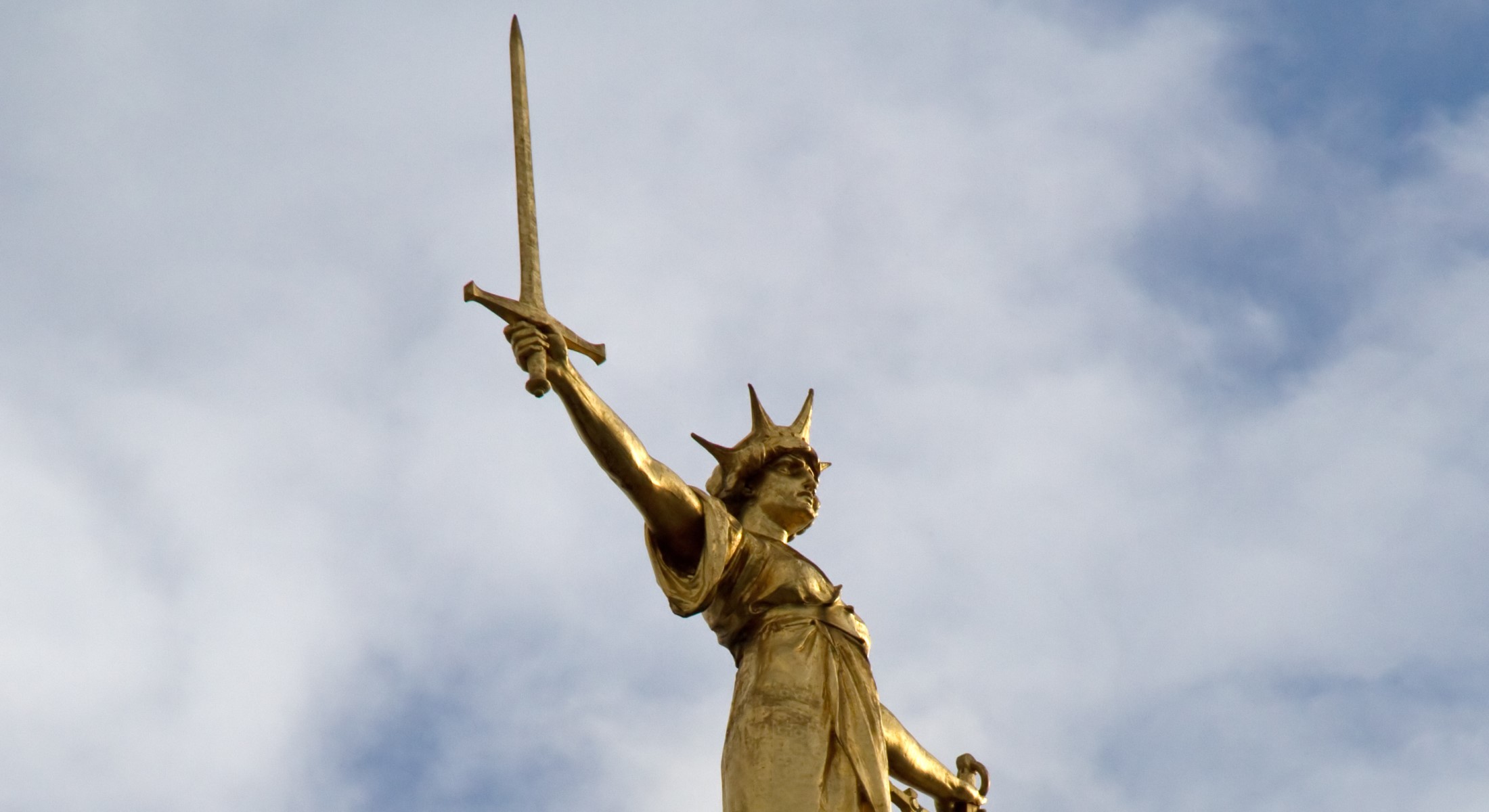
On top of the Old Bailey in London stands an enormous bronze sculpture of Lady Justice, holding scales in her left hand and a sword in her right. People might assume the sword only represents punishment. But at a deeper level it symbolises the power of justice to decide between right and wrong, lawful and unlawful. In some languages, the word ‘to decide’ in a legal case means ‘to cut’ (such as trancher in French). In Biblical Hebrew, God literally ‘cuts a covenant’ when he decides to enter into a new relationship with his people. And in English, too, even our word ‘decide’ comes from the Latin de-caedere, ‘to cut off’…
Hence the sword of decision.
Now in the Gospel today, John the Baptist speaks of an ‘axe’ and a ‘winnowing fork’, rather than a sword, but the underlying message is the same: there will be a decision, we will be judged. The axe moreover speaks of punishment: ‘Every tree therefore that does not bear good fruit is cut down and thrown into the fire’ (Mt 3:10). The winnowing fork is more like the sword of decision and applies an objective standard (what has substance versus what is superfluous) to separate out the wheat from the chaff.
We must never forget that God’s judgment is objective and perfectly fair. St Paul speaks of ‘God’s truthfulness’ in our Second Reading (Rom 15:8). This truthfulness of God gives us hope (Rom 15:4) and assures us that his offer of mercy is extended to everyone, including all the Gentiles (Rom 15:9). God himself is the standard of justice; his logos (word or reason) is the epitome of rational judgment. And the Logos became human in Christ (Jn 1:14).
In a traditional sculpture of Lady Justice (though not on the Old Bailey), fairness is indicated by her being blindfolded. Perhaps this echoes what we just heard from the Prophet Isaiah, that the descendant of Jesse ‘shall not judge by what his eyes see, or decide disputes by what his ears hear, but with righteousness he shall judge the poor, and decide with equity for the meek of the earth’ (Is 11:3-4). In other words, the Messiah is not blinded by merely human appearances, but is enlightened by the Spirit of wisdom, understanding, counsel and knowledge. So we could say that God’s justice is not blind, precisely because he sees with absolute clarity into the truth of our hearts. ‘For the Spirit searches everything, even the depths of God’ (1 Cor 2:10).
John the Baptist did not mince his words of warning. But before we rush to condemn the Pharisees and Sadducees (hypocrites that we are!), let’s notice two things. They are ‘coming for baptism’ (Mt 3:7 RSV) – yes, they are confessing their sins and asking for mercy. While John castigates them as a ‘brood of vipers’, he seems to acknowledge the beginnings of grace in them when he warns them to go further: ‘Bear fruit in keeping with repentance’ (Mt 3:8). Secondly, in Luke’s account, the Baptist calls everyone in the crowd a ‘brood of vipers’ (Lk 3:7). Don’t we all need to repent?
This Advent, as we wake up again to the fact that we will be judged by God, we are emboldened by John the Baptist’s preaching to face that winnowing fork – that sword of decision – and apply it already to ourselves. By God’s Holy Spirit at work in us, we can ‘prepare the way of the Lord’ by starting that work of cutting out what is bad, to preserve and nurture what is good. Then we will be able, with St Paul, to ‘glorify God for his mercy’.
Readings: Isaiah 11:1-10 | Romans 15:4-9 | Matthew 3:1-12
Image: detail from the statue of Lady Justice on the roof of the Old Bailey, London, photographed by Tony Hisgett via Wikimedia Commons (CC BY 2.0)